
 For the last 30 years or so in the semiconductor industry we have sold a concept that might just have been wrong! This is a mindset shift that we can make now and that could easily have been of great positive impact had we recognized it much earlier. And this shift in thinking that I will propose could easily apply to any number of industries and market places.
As always with shifts in thinking, not everyone will understand the differences, or choose to accept them, and that is quite OK. And those that do (you) will benefit from the shift in methodology that this shift in mindset sets up.
So what is this epiphany?
In our past, we have worked to make sure our clients were fully informed and understood the TRUE Total Cost of Ownership. Total Cost of Ownership discussions required us to put negative facts on the table that the people we were working with may or may not have actually taken time to include in their analysis of the choices they had made. Most of the time, as sellers of the “preferred” solution, we detailed a specific, unrecognized, significant cost factor that raised the costs of the “other” solution when factored in.
In the case of the semiconductor industry, in the early days of the concept of “field programmability” we pitted our “flexible” solutions against the non-flexible offerings of what were called mask programmable solutions. The true cost of ownership of a mask programmable solution actually included many elements that were not normally included in the price comparison at a piece by piece level. There were up front manufacturing costs in the “other” solutions that would be thousands of dollars, there could be the scrap costs as many times these less flexible solutions needed changes to finally function. It was really an easy conversation to have.
And in actuality, it probably was NOT wrong for its time. Those were different times, and we were selling an education, not just products in these cases.
That was then, however, and the same old thinking will NOT get us where we need to go today. Talking just about cost is the same as talking just about price. We need a different perspective – a differentiated perspective if you will.
So, no more Total Cost of Ownership.
Its time to change the words, that will change the thinking, that will change the actions, and get the results we want.
So instead, we need to talk about Total Benefit of Ownership.
A minor shift in words and a huge shift in thinking, discussion, and action.
If Total Benefit of Ownership is BETTER, BEST is Total Profits Added.
You can easily imagine the 2-way conversations that you will now have with a client when you start to position your answers to their needs in terms of the benefits that can be achieved by the client when they execute on the ideas that you CO-CREATE with them.
That focus on achievement outcome from a positive perspective is only made more powerful when you, together, take the time to specifically spell out how the impact that actions taken in the directions created by you and your client will actually generate ADDED PROFIT of $$XXX. Not just revenue, but bottom line profit. Having that level of discussion and spelling it all out at that detail level demonstrates your complete commitment to the success of the client and the people you are serving.
As you do this, you can rest assured that you will be in a unique perspective with your client, as everyone else is stuck back at product features, benefits, and cost.
You WIN!
Time for a discussion about TOTAL BENEFIT ADDED!
 It seems that the wave of the sales revolution is picking up steam. Just now we are seeing many “sales experts” announce that the role of the salesperson is gone. The internet has won and people in selling can be replaced by specialized recognition systems driven by big data manipulation running on machines.
First of all, where the heck have they been? The commoditization of information via the internet is not new - it is just moving at a non linear rate that is staggering and catching everyone’s attention. As of April of 2015 (ancient times in the data world) the stats are crazy. Ninety percent of the world’s existing data has been created in the last 2 years. Every day we create enough NEW data to fill 10,000,000 blu-ray discs (remember those?), which when stacked would measure the height of 4 Eiffel Towers on top of one another. EVERY DAY… a year ago. (No newer validated data that I can find.)
Secondly, those same pundits who forecast the demise of the salesperson are both right and wrong. They are right - if the sales professional questioning their existence does not make a huge mind set shift and follow that up with an equally huge methodology shift. So that opens up the door to the fact that they can be wrong, and the outcome is actually in the hands of the individual sales professional themselves.
My premise, along with a good friend and colleague, Hendre Coetzee, is that this massive amount of information that overloads people is actually a catalyst for the need for even better professionals in selling, helping clients understand good from bad data, make better decisions, and make them faster than ever before. Today’s very best sales pro is the master of understanding and simplification. Understanding how to help their clients make the world a better place, and simplifying the client decision-making process. While these both seem very holistic, they are actually very practical motivations and outcomes.
Preparation is the key to it all. No longer can the sales pro strap on their product selector guide and hit the street and do any real work. Now we must start with a serious focus on understanding each client, and the role of specific people in that client, and figuring out how to help them better view the myriad of product and solution options that are in front of them.
We need to understand, at a high level, the industry that they are in and many of the fundamental challenges that exist in that industry. It takes more preparation time than ever before to be able to help our clients make a real difference, because we must first determine what that will look like. When we get into this level of conversation the first push back we hear is that “we can’t be expected to know our client’s business better than they do”. While even that is arguable, the primary response to that is that we CAN be expected to know what impact our products and solutions will have on their business better than they can.
And to do this well we have to make a shift away from OUR view of the world and shift it into a view of THEIR world…then merge the two.
Hendre and I are writing a book in which we guide the mindset shift as well as explore some of the methodology and skillset shift that is required to remain relevant and successful in selling in today’s business climate. We are excited to show you how you can become a depended-upon resource for client specific solutions of any kind. Despite what many say, the sales professional indeed has an important and necessary role to play today. But it requires core shifts in mindset and skillset – stay tuned!
In the meantime, my good friend and colleague Dave Brock has just released the Sales Manager Survival Guide. The book has already reached number one in Amazon Kindle hot new books in sales and marketing.
The Sales Manager Survival Guide is packed with everything a front line sales leader needs to succeed. Purchase Dave’s book on Amazon to both Get Smarter and to Do Good. Congratulations Dave!
 As sales people we hear it all the time – it’s all about driving to The Close. When are you going to close that deal? What do you need to do wrap this up?
The majority of sales training for the last several decades has been focused helping the sales person close the deal. There are techniques to Trial Close, to Pre-Close, to Soft Close, and even to Reverse Close. That one is where you actually tell the client that you can certainly see that they are not yet ready to take advantage of this great offer, so let’s just forget it for now – a bit of negative psychology that sadly worked. And sadly many complex B2B sales people in this world are still doggedly working on their Close.
For them, for all of us, I have just two words – STOP CLOSING!
Wait, what?
Yeah, I just said that. Stop closing. You’re probably thinking, what do you mean, I should stop asking for the order? Nope, I did not say that. I’ll explain a bit later.
It’s time to make a mindset shift. Then we will shift our methodology. Shifting our thinking about The Close is critical. In the past The Close was seen as the grand finale. We all fell prey to that central theme. And while once The Close was the end, now it’s just another point on the way to this question: What’s next?
In past years, (for me decades), we have all been a part of or led sales training where a group of trainees is give a sales role playing situation to analyze, create a client pitch deck and then present a story to a panel of sales judges. The winners of the competition get the sales geek of the year award. Been there and done that a bunch!
As a trainer and a judge, I was always amazed by the groups of professional sales people that would do all that work and make brilliant customer pitches, and then neglect to ask for the order.
My experience has been that about half of the teams would not ask for the order. In my early years I saw this as a fatal flaw of the trainees. Teams that did not ask for the order were booted out fast. However, a role-playing simulation like this has a fundamental limitation: it cannot capture the scope of client engagement that needs to happen in the sales process. We were busy scripting a great pitch that ended with handing the client a pen to have them sign on the dotted line. The Close was also The End.
This is the real problem: we have assumed that the most important step in the selling process is the close. We see it as the end point of our client engagement –we “drive to the close” – when really, asking for the order is not the end at all.
Even in highly transactional selling like the Fuller Brush man or selling Girl Scout cookies door-to-door, the seeming end point of closing is really just the NEXT step in the never ending client engagement process. Right on the heels of getting the order, comes the Verification process where our aim is to clearly get a shared understanding of the value that has been created in the clients eyes by the work that you have done. From the verification process you escalate the discussion to other needs that that were identified through the journey in the first transaction. And the cycle of client engagement starts again.
There are 5 basic sections to the development and delivery of insight to a client and the drive to a closure is one of them. You’ve gotta ask for the order – it’s just not the end that it seems it would be. It is actually the springboard to the NEXT piece of business with the client. The door is never CLOSED!
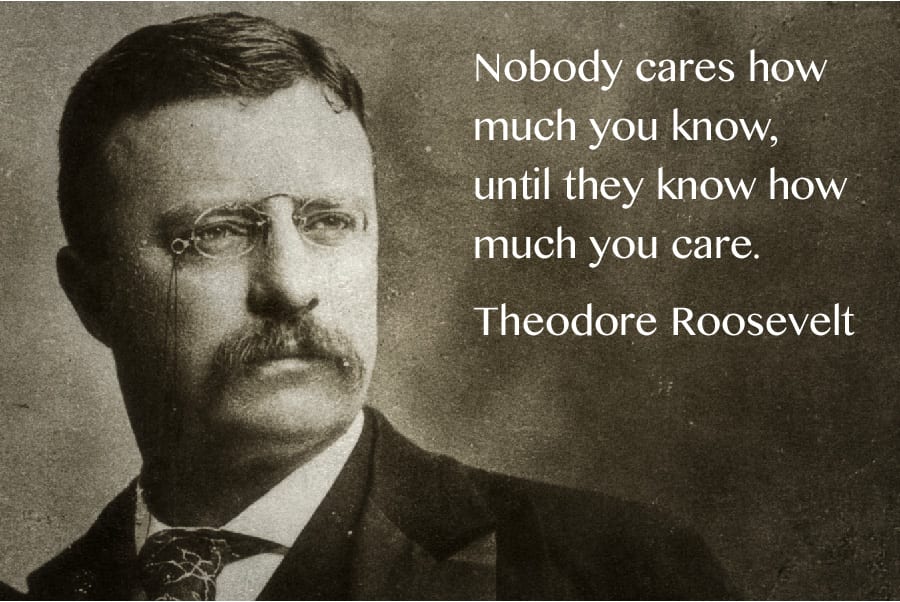
Nobody cares how much you know, until they know how much you care. - Theodore Roosevelt
As sales people our past success over several decades has been driven by data - data in the form of what we KNEW. Our success in “selling” was once based on the information that we had in our heads, the people that we knew, the contacts that we had, and the resources that we knew how to deploy.
Unfortunately, today significant portions of what once made us winners no longer matter, and many of us still can’t get over the ways of the past.
In a recent blog, a friend and fellow sales fanatic, Dave Brock wrote about how poorly many sales people today prospect for clients. Check out his thoughts, they are great. I see the same thing today from EVERY single call and email that I get from salespeople who are wanting a piece of my time.
The message starts like this:
“Mitchell…”
(We can stop right here because clearly my name was picked out of some database somewhere. The only person ever to call me by my full name was my Mother, when I was in trouble.)
“Mitchell, my name is Bob Blah and I would really like to have just 10 minutes of your time to tell you all about my blah, blah, blah. We are number one in blah, blah, blah. And today we serve 159 of the Fortune 500 companies. Our blah, blah, blah, will help you sell more and solve all of your problems.”
I actually do not pick up my office phone any longer because these calls come all day, every day. It’s sad. If just once, one of these hard working folks would call up and demonstrate that they actually cared about what was important to me, I would be delighted to call them back. But in the last decade that has never happened. Not even once.
To connect with the people in our lives, while selling or not, we have to CARE, and we have care about THEM.
Our understanding of what is important to THEM, what their challenges are, and how we can help, must come before we ever get into a discussion about our products or services or anything to do with us.
Our clients will care about what we have to say, ONLY when we clearly demonstrate that we care about them FIRST. And it must be in that order. And it must be genuine and sincere. No games, no pitches, no opening and closing strategies, no handling of objections, no manipulation, no SELLING!
Start with caring about them as people, not them as a part of a company. Do your homework about their world. Understand what you can about their issues in their company, their challenges in their industry, the risks that they face daily in innovation… And keep seeking to understand, because you care. Turn the understanding and caring around to focus on the person that you are serving.
You will find that those people that you care enough to serve well from their perspective will in fact care a great deal about what YOU have to say, in time. And from there the caring and information sharing explodes.
Your clients care because you care. You first!
Once upon a time our value as sales people was information. It actually still is, but the new reality is that to get to the point in a client relationship where your information is again valuable, you must enter into that relationship from the perspective of listening and diagnosing first, extensively, before you prescribe.
Sounds easy, but most sales people that I interact with today are still pushing their stuff on me before they have ever stopped to understand me. Too bad. Their loss, and our gain, since we know the secret… CARE about the people who you serve.
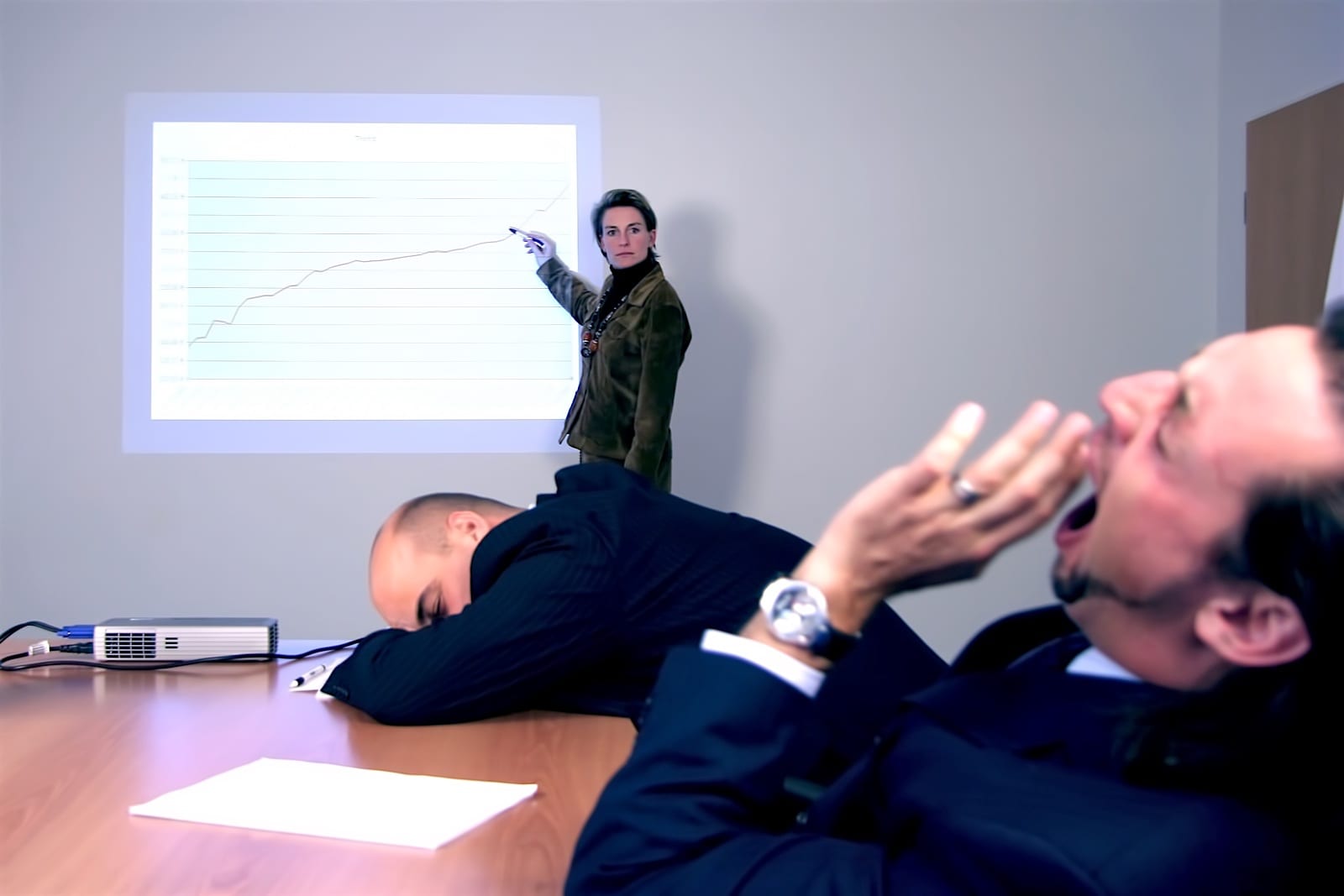
Please. Stop giving presentations.
Now, let me expand and explain. One of the very worst tools to ever be used by a sales person is PowerPoint. Not that it is bad on its own, just that we all use it as a crutch. We have all misused the true power of the tool because it is what we have seen everyone else do: stand in front of a client and roll through 30+ slides that tell them about what we do. Boring, and not in the least effective. And yet we still continue to do it. We have all said the phrase “please stop me and ask questions” during one of our mind-numbing presentations. And the clients almost never do. It is just the way it is… or WAS.
My challenge for you for the next 2 weeks: give NO presentations.
Instead, have good two-way conversations.
Keep PowerPoint in hiding and the laptops closed. Go old world, take out a piece of paper and take a FEW notes. Prepare for and hold very interactive conversations with your clients. Have conversations with your clients that matter to them. Conversations that matter are 75% listening and 25% asking questions. Good questions contain the information that you want to communicate. For example: “Bill (client) I understand that one of your suppliers has just announced another round of EOL (End of Life) devices. Will that be impacting you this time?” You are delivering a message AND asking a question. Conversations like this take planning on your part and a deep understanding of the client.
Here is another way you can do the same thing (this data is actual survey data from our clients). You are talking to an engineering manager in your client. It may be a first conversation or just another in the long line of visits. “Bill, at Microchip we have over 100,000 clients world wide. In a study that we have just completed with our global client base we uncovered some surprising data. More than 30% of our clients are spending more than 30% of their engineering resources on fixing problems like EOL that semiconductor suppliers have caused. And the average redesign cost was in excess of $150,000. That’s a staggering amount of money and time wasted. At Microchip we don’t cause that, and I’m wondering what your experience is in this situation.”
Now, let’s set the stage further: You are having this conversation, and as you start, you stand up and approach a white board, or you open your notepad to a blank piece of paper, and you write EOL in big letters on the top. You start the conversation above and make 3 notes:
Then you write MCHP and put a big ZERO beside it as you close the comment. Then you hand them the marker or the pen and ask them what their experience is.
Now this is just one conversation that you can pretty well use universally. This is a good example to show the planning that must go into having a good two-way conversation. Your Plan/Do/Review commitment is absolute if you wish to have conversations with clients that matter to them and to you.
So, step away from the Powerpoint. Step away now. Plan your next call, prep the conversation, simulate the conversation with a friend, and take the time to really care about your client and what their focus is. Even if a client expects a “corporate overview” from you, do it without Powerpoint.
Make it a conversation, not a presentation. Make it different and you will stand out from the crowd. You know the material you need to cover. All you need to know is what matters to them. All you have to do is ASK. You will be surprised what the ensuing conversation will become.
Again, the challenge: NO presentations for 2 weeks.
It’s shifting mindset AND methodology! Let me know what happens.
