
I ran across an individual this week that was struggling during our Covid challenged times with why they were doing what they were doing. They said that they were struggling with feeling a sense of purpose these days. It felt like they had lost their real reason for working so darned hard. We spent a lot of time on the topic. I will share a few pages of my book SHIFTABILITY that dig into this very critical perspective. And rather than dump it all on you at once I will cover this over the next few weeks… (please remember that ALL of the profits from SHIFTABILITY, on Amazon, are given to charitywater.org to create clean sources of water for those folks that do not have that)
Efforts and courage are not enough without purpose and direction – Jonn F Kennedy
For hundreds of years, navigators and lost souls have found their direction using a compass. At its simplest, a compass is a floating magnetized needle that aligns itself with the magnetic field of the earth to point north. Once you find north on your compass, and knowing that the sun rises in the east and sets in the west, you can then find the direction you need to go to reach your destination.
As we navigate our way through life and business it is easy to lose our way, especially when the world we have known is in upheaval around us. We need a compass that keeps us aligned with our true north and moving in the right direction. Discovering our purpose and keeping that purpose in our sights will help us navigate. Our purpose is our true north.
The question of purpose is a very central conversation in business today. Companies are talking about it, managers are wrestling with it, employees are seeking it. But while this is a current discussion, it is certainly not a new one.
Humanity has wrestled with the question of purpose since the dawn of time. Why are we here? What are we supposed to do? We are wired for meaning and driven to find it, not just in our personal lives but also, and perhaps especially in our professional lives or our vocation. Our personal sense of purpose and our professional purpose are inextricably intertwined. However, for the purposes of this book, we are going to be mainly talking about purpose in the context of your work as a sales professional. 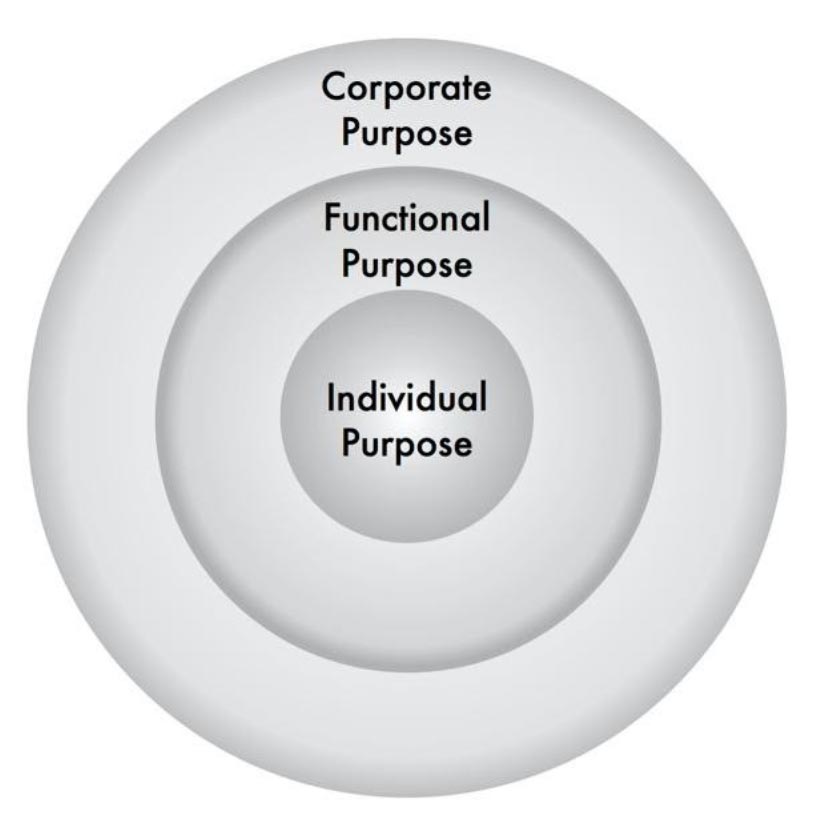
Understanding purpose in the workplace is central to success in selling and a core element of this quality of shiftability that we are exploring. Our work is driven by purpose, defined by a purpose, and ultimately serves a purpose. Our desire for meaning and to serve a greater purpose fuels (energizes) our activity; our understanding of purpose in our context determines how we engage and the moves we make; and ultimately, what we do and how we do it should all aim to serve a purpose. What that purpose actually is will be unique to the context in which you operate.
As a sales professional the context of your purpose is threefold – your individual purpose, the purpose of your role (functional purpose), and the purpose of your organization (corporate purpose). The alignment of these three frames of purpose is where you can make a powerful difference.
But before we dive into understanding these three frames of purpose we are going to clear up some potential confusion between purpose, vision, mission, and values, and take a look at the big picture of purpose and selling.
Sometimes we think we are talking about purpose but we are actually talking about mission or vision or values. These are all very distinct ideas with important but different implications and applications.
A mission statement describes the type of work you do, the clients you serve, and the level of service you aim to deliver.
Example: “We are in the business of providing world-class logistics software to medium-to-large firms in the manufacturing industry.”
A vision statement describes where an organization wants to be in some years ahead and sets long-term goals. Vision sets a future context for day-to-day thinking – will the actions we are taking and decisions we are making today move us toward where we want to be? Vision statements are often aspirational: to be the best, to be the leading company, to have our product in every home, etc.
Example from Amazon: "Our vision is to be earth's most customer-centric company; to build a place where people can come to find and discover anything they might want to buy online." (I personally feel this needs a LOT more color and details to be a GREAT Vision…. But that’s just my perspective – Mitch)
Values describe how an organization operates. They set out the desired culture and serve as a compass for conduct.
Example: “We are committed to client satisfaction and serve our clients with care and compassion. We operate according to principles of accountability, sustainability, and responsibility.”
Mission explains what we do and whom we do it for, vision tells us where we aim to be, values direct how we do it, and purpose tells us WHY. Simon Sinek, the author of Start With Why, has said, “All the great organizations in the world, all have a sense of why that organization does what it does.” Understanding why an organization exists informs everything else. Purpose statements are generally more outward-looking and consider the impact an organization or person has on the world around them.
Example from Apple: "To make a contribution to the world by making tools for the mind that advance humankind."
Selling without a clear purpose is like driving across the continent without a map. It can certainly be done. A lot of people do it. But it is NOT the most effective way to cover the distance and reach your destination. And like that cross-country journey selling takes a lot of support teams to make it happen.
If you start the trip without clearly defining your destination, you can still get somewhere. The question will be – is that where you really want to go? How do you know? How can you tell?
Just “winging it” and “flying by the seat of your pants” in the sales jungle was once the brave thing to do. Now it is just stupid. Now it takes a clear understanding of what you are aiming to accomplish, it takes tons of planning and preparation, and it takes diligence in execution. You can no longer serve the needs of today’s information-savvy client by just showing up with the latest product brochure in hand. Now you must have a deeper understanding of the customer, their market, their products, and their business challenges, and the implications of those challenges. And you must start all that with clearly understanding what you are aiming to do from a higher-level perspective of purpose.
And while the noble cause of making a profit may in fact be a fine goal, in this case, it does not qualify as a purpose.
A company’s core purpose, as defined in Built to Last by Jim Collins and Jerry Porras, is “the organization’s fundamental reason for being. An effective purpose reflects the importance people attach to the company’s work – it taps their idealistic motivation -- and gets at the deeper reasons for an organization’s existence beyond just making money.”
From both a corporate and a personal perspective, we like the simplification of this idea that Roy M. Spence and Haley Rushing have in their book It’s Not What You Sell, It’s What You Stand For. In their book they give the following as their simplest way to explain purpose: “Purpose is a definitive statement about the difference you are trying to make in the world”.
Both books clearly show that purpose-driven organizations are amongst the most successful in the world and that leaders who clearly understand the power of purpose drive these organizations.
Understanding and having a clear purpose may not be the answer to everything needed to be successful. Without it, however, the battle to succeed is made more complex and many times more likely to be lost. The choice is yours. Lead and sell from a clear purpose – or not.
Selling with purpose, or purpose-driven selling is about creating value for people through understanding what they need as an individual in their corporate role and then providing solutions. This requires understanding your own individual purpose and your functional purpose for why you sell and understanding the corporate purpose for what your company stands for, not just what it sells. All wrapped together, purpose-driven selling provides a unique client engagement level that everyone, client included, values more.
When we start talking about purpose, the term “selling” can be understood in a different way. When you are fully engaged in purpose-driven selling you are not actually selling. You are helping someone buy, or acquire, whatever it is that they need to fulfill their purpose at that time. Again, a subtle shift in thinking makes a big change in how we communicate and how we engage with clients. Selling is simply a transaction that enables purpose – your client’s purpose, your company’s purpose, and your purpose.
More on individual purpose to follow…
Really. Is that the best question we can ask? Sure seems like it. I chat with other sales leaders and gurus in our occupation and I hear a term that makes me shudder… Deal Review. Now, I have been around this world for nearly 7 decades, and this term is not new to me. Sadly, it is still used in today’s complex sales environment. The conversation sounds something like this…
The setup… an account rep is in front of a whole gaggle of corporate executives trying to change their “situation”. Often times this is at the end of a month or a quarter and the corporate folks are doing everything they can to squeeze blood from every stone and meet those financial commitments that they made to the street.
The conversation is a seemingly benign one with a simple question… “So, Salesperson X, we see this really large deal that is in your funnel is still not done… what will it take to “CLOSE THE DEAL?”. And this is the same routine that they are going to go through endlessly with each salesperson with a desperate attempt to counter the fact that there actually has not been any real client value created and the possibility of “CLOSING THE DEAL” will come down to deep discounting, extending payment terms, offering a value-added element for FREE, or otherwise giving away the family jewels in desperation. Sadly again, this process seems to be institutionalized by many selling organizations and even the clients know it, so they wait till selling desperation sets in and go for the big money discount payoff. And it works!
Sound familiar? It’s a disease that is almost everywhere. Giving things away out of desperation and in an attempt to cover up the fact that the true value creation job has not been done. Salespeople are used to it. Sales leadership builds it into their DEAL REVIEW process. Corporate management is the worst.. they drive the dialog out of an even bigger desperation perspective and it is all well oiled by individual commission systems that simply do not care about client value, only revenue dollars.
What is an out-of-the-box thinking person to do here? It’s not terribly difficult. We must change our view of serving a client and NOT closing “deals”. We know we still have objectives that are important. We don’t ever get to ignore that. My perspective is that, like “sales”, we are the revenue engine for our corporation. A task that is not taken lightly. Our deeper objective is the continual GROWTH of revenue, at or above corporate gross margins. We don’t discount, and we don’t give things away. Both of those actually erode the client value and commoditize valuable relationships doing much more harm and setting the tone for a relationship that has you seen as a “vendor”, not an asset.
Our role with a client is to co-create value that THEY recognize AND get rewarded for doing it.
Let’s kill the words DEAL REVIEWS. Let’s build a process and a dialog that focuses on the client-recognized VALUE that we have co-created and that THEY have acknowledged. Only by shifting our focus away from the very weak perspective of the DEAL do we open up the total dialog to a much higher plane around CLIENT VALUE. My suggestion is that we rename this entire thing to CLIENT VALUE REVIEWS! Words matter!
DEAL REVIEWS… may you rest in peace!
Long live CLIENT VALUE REVIEWS!
Now, let’s go demonstrate the value of this to all those old souls in our ranks that are still stuck in pre-COVID time. Evangelists are always needed to help those less open to seeing the new light.
OK, LET’s ROLL!
Mitch
And let's start right off with that does NOT mean we can BUY our way into a winning position. The lowest price equates to LOWEST value in most cases. I sadly see it every day. Our products and services are all world-class. Our deliveries are competitive. Our prices are in line with what the world sees as reasonable. We can leave it that and see how we do… Or NOT. As many times as I have said it, and it has in theory been “heard” it is worth repeating, and it is critical to absolutely understand, that it is our Value Added efforts at a client that are the difference-maker. It is what we DO that makes the only difference that truly matters. Now…value-added must be in the eyes of the client. How do you know what matters to them? Simple…ask them…. It goes like this… “Hey Karen (client), several of my long-term clients tell me that what they value the most from a supplier partner is their ability to bring me insight into my industry that I did not have. We find that there are significant similarities in the thousands of clients that we serve. Would it be of value to you if I offer up a few of the trends that we are seeing today in clients similar to you?" You can’t wing this one, you actually need to do the planning work and conversation simulation needed to actually bring value to the table.
Insight comes in many forms and for it to be of value to the client we need to understand their very specific challenge so that we can tailor our efforts towards helping them make better decisions, quicker. One barrier to the decision-making process is the client’s own ability to facilitate change in their own world. That can be a huge barrier that you CAN help them navigate. It requires a clear consensus creation within their organization and ALL of the people involved in the thinking around the issue. You CAN become a change agent to help them tackle that problem. It too starts with asking the client, “who all do you believe will be needed to make this happen?”. There is a LOT of science around change-facilitation. I choose to take it back to basics about caring about the people that we serve. As long as our motives are pure….helping them, then our actions do not have to be deeply steeped in psychology. Keep it simple and remember that we are aiming to help PEOPLE, not companies, INDIVIDUALS, not corporations. Start out of the blocks with caring!
CUSP
CARE greatly,
UNDERSTAND deeply,
SERVE endlessly, with
PURPOSE
Dig deeply into each one of those 4 steps and create the PLAN/DO/REVIEW steps to bring the conversations to the surface. Simulate the conversations with your team. Tweak it all, and take it to the street with LOVE as the intent.
OK, LET’S ROLL!
Mitch
I decided to go back to what I was writing years ago and see if it all still made sense. And from nearly 6 years ago here is what I found…. I love that even then the thinking of CUSP was at the core.
CUSP
CARE greatly,
UNDERSTAND deeply,
SERVE endlessly, with
PURPOSE.
OK. LET’s ROLL!
Mitch
------------------------------- from Nov 2015-------------------------------
Nobody cares how much you know until they know how much you care.
Theodore Roosevelt
As salespeople, our past success over several decades has been driven by data - data in the form of what we KNEW. Our success in “selling” was once based on the information that we had in our heads, the people that we knew, the contacts that we had, and the resources that we knew how to deploy.
Unfortunately, today significant portions of what once made us winners no longer matter, and many of us still can’t get over the ways of the past.
In a recent blog, a friend and fellow sales fanatic, Dave Brock wrote about how poorly many salespeople today prospect for clients. Check out his thoughts, they are great. I see the same thing today from EVERY single call and email that I get from salespeople who are wanting a piece of my time.
The message starts like this:
“Mitchell…”
(We can stop right here because clearly my name was picked out of some database somewhere. The only person ever to call me by my full name was my Mother, when I was in trouble.)
“Mitchell, my name is Bob Blah and I would really like to have just 10 minutes of your time to tell you all about my blah, blah, blah. We are number one in blah, blah, blah. And we today we serve 159 of the Fortune 500 companies. Our blah, blah, blah, will help you sell more and solve all of your problems.”
I actually do not pick up my office phone any longer because these calls come all day, every day. It’s sad. If just once, one of these hard-working folks would call up and demonstrate that they actually cared about what was important to me, I would be delighted to call them back. But in the last decade that has never happened. Not even once.
To connect with the people in our lives, while selling or not, we have to CARE, and we have to care about THEM.
Our understanding of what is important to THEM, what their challenges are, and how we can help, must come before we ever get into a discussion about our products or services or anything to do with us.
Our clients will care about what we have to say, ONLY when we clearly demonstrate that we care about them FIRST. And it must be in that order. And it must be genuine and sincere. No games, no pitches, no opening and closing strategies, no handling of objections, no manipulation, no SELLING!
Start with caring about them as people, not as a part of a company. Do your homework about their world. Understand what you can about their issues in their company, their challenges in their industry, the risks that they face daily in innovation… And keep seeking to understand, because you care. Turn the understanding and caring around to focus on the person that you are serving.
You will find that those people that you care enough to serve well from their perspective will in fact care a great deal about what YOU have to say, in time. And from there the caring and information sharing explodes.
Your clients care because you care. You first!
Once upon a time, our value as salespeople was information. It actually still is, but the new reality is that to get to the point in a client relationship where your information is again valuable, you must enter into that relationship from the perspective of listening and diagnosing first, extensively, before you prescribe.
Sounds easy, but most salespeople that I interact with today are still pushing their stuff on me before they have ever stopped to understand me. Too bad. Their loss, and our gain, since we know the secret… CARE about the people who you serve.
Are you curious?
If you are a curious sort, just that question alone should have got your attention. The reality is that curiosity did NOT kill the cat… IT MADE THE SALE!
We have all had great conversations with people that flowed well and seemed to go on and on. And we have had the opposite, major flops. In the case of the latter, and in the realm of selling, it is almost always due to our own self-interest and an overwhelming burning desire to TELL our story to the potential client.
Now on its own, without understanding the client and setting up all of the connections that tactic will simply cause endlessly glazed-over eyes outcomes. Your time will come to talk about your stuff…be patient.
And create curiosity!
The genesis to great early on conversations is the layering of little bits of credible client-focused information between layers of curiosity creating questions or thoughts. A bit of contextually specific information, the posing of a curiosity creating question… tee up the next bit of new information… add in another curiosity provoking thought…repeat till done.
This all must be planned out in advance of the conversation. You will be best served if you can simulate it with a friend and get comfortable with the iterating style.
If you are not curious about your client it will show to them in your conversations. Our sales world is way too full of people that simply want to “tell you all about MY stuff”. And our clients know that and until you prove that you are different and provide value that they acknowledge you will be stuck in the short loop chat routine, going nowhere.
So, here is an idea… be curious about what unique outcomes your “stuff” can create with your client. Put your “stuff” value into their terms. This too will take some specific client prep work. So just do it! Dig in, find out what business challenges your client is facing, build some solutions to that, create some conversation simulations around the curiosity of how to communicate the value… and get it done!
All of this is a continuation of the grand theme of making the world a better place by serving. And of course, it looks like this…
CUSP
CARE greatly,
UNDERSTAND deeply,
SERVE endlessly, with
PURPOSE
And, have a little fun while you are creating massive amounts of curiosity.
OK, LET’s ROLL!
Mitch
