
This is an excerpt from my forth-coming book with Hendre Coetzee, Shiftability: Creating a Sustainable Competitive Advantage in Selling which will be released in early 2017. Sign up for my email newsletter on the homepage to receive more information about Shiftability.
Mark Twain said, "The two most important days in your life are the day you are born and the day you find out why."
Wondering why we are here is fundamental to the human condition. It’s a profound moment when we start to catch a glimpse of just what our purpose might be. This discovery is the starting point of living an intentional life aligned to your purpose.
Many authors wiser than we are have written extensively on the notion of personal purpose and living a purposeful life. There’s a lot to be said – more than we will attempt to cover here. But there are a few points we would like to make.
As a sales professional your sense of individual purpose is central to your success and effectiveness. If you don’t have an understanding of your own purpose, you need to take the time to identify and define it for yourself. Understanding your purpose is not just a process of discovery and recognition; it’s also a process of declaration and decision.
For some there is an obvious natural gifting and calling to be stepped into. For the rest of us, purpose is more about choices and determining how we want our story to play out. Napoleon Hill, author of Think and Grow Rich wrote, “What a different story men would have to tell if only they would adopt a definite purpose and stand by that purpose until it had time to become an all-consuming obsession!”
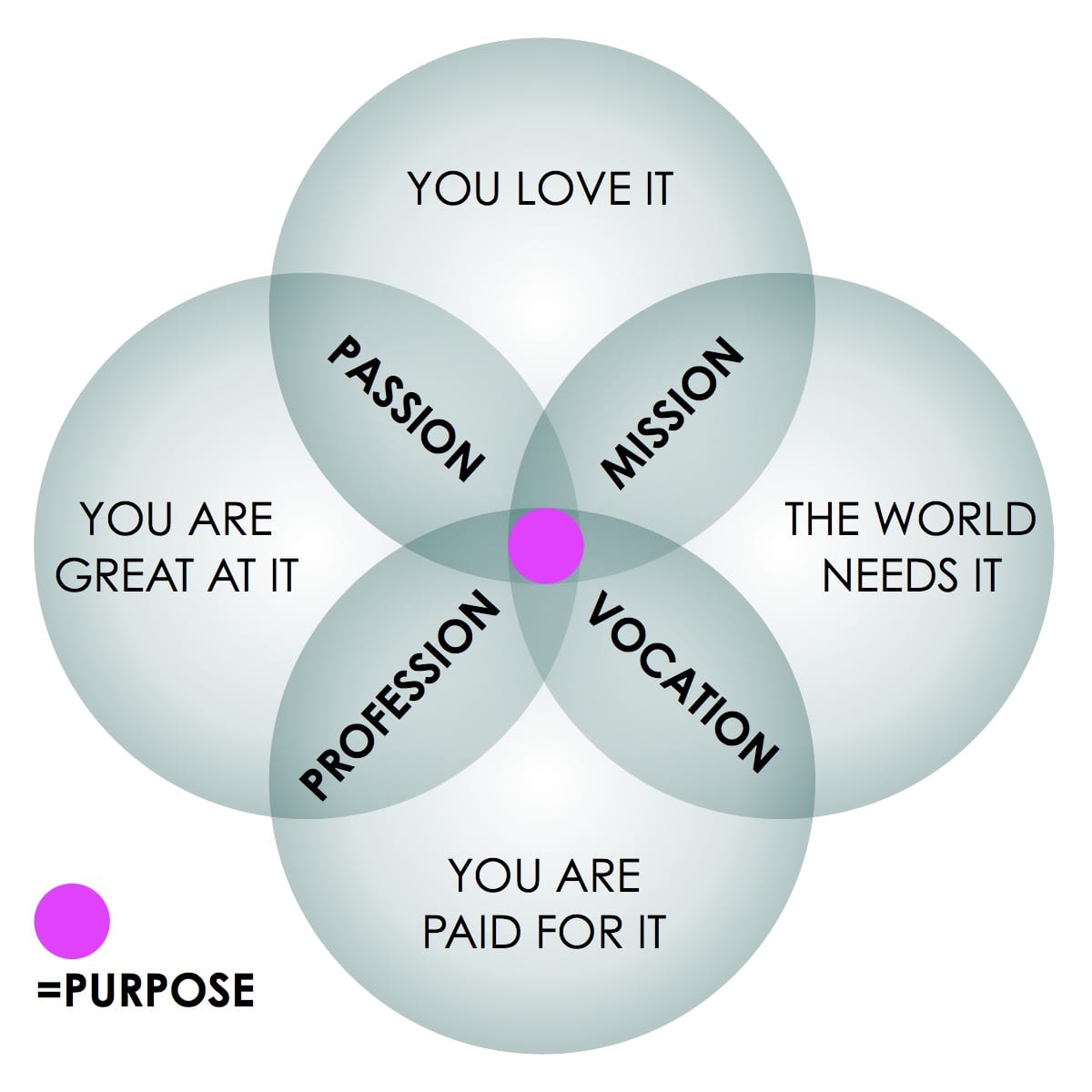 We like this simple diagram that illustrates how the different spheres of your existence overlap and intersect. In this perspective your purpose is found at the intersection of your passion, mission, profession and vocation.
These are some common elements of individual purpose:
This last point brings us back to Spence and Rushing’s definition of purpose being a statement made about the “difference we are trying to make in the world.”
Jackie Robinson said, “A life is not important except in the impact it has on other lives.”
What kind of difference do you want to make? This is a question you should ask both personally and professionally – because you can make a difference as a sales professional.
This is an excerpt from my forthcoming book with Hendre Coetzee, Shiftability: Creating a Sustainable Competitive Advantage in Selling which will be released in early 2017. Sign up for my email newsletter on the homepage to receive more information about Shiftability.
Selling without a clear purpose is like driving across the continent without a map. It can certainly be done. A lot of people do it. But it is NOT the most effective way to cover the distance and reach your destination. And like that cross-country journey it takes a lot of support teams to make it happen.
If you start the trip without clearly defining your destination you can still get somewhere. The question will be is that where you really want to go? How do you know? How can you tell?
Just “winging it” and “flying by the seat of your pants” in the sales jungle was once the brave thing to do. Now it is just stupid. Now it takes clear understanding about what you are aiming to accomplish, it takes tons of planning and preparation, and it takes diligence in execution. You can no longer serve the needs of today’s information-savvy client by just showing up with the latest product brochure in hand. Now you must have a deeper understanding of the customer, their market, their products and their business challenges and the implications of those challenges. And you must start all that with clearly understanding what you are aiming to do from a higher-level perspective of purpose.
And while the noble cause of making a profit may in fact be a fine goal, in this case it does not qualify as a purpose.
A company’s core purpose, as defined in Built to Last by Jim Collins and Jerry Porras, is “the organization’s fundamental reason for being. An effective purpose reflects the importance people attach to the company’s work – it taps their idealistic motivation -- and gets at the deeper reasons for an organization’s existence beyond just making money.”
From both a corporate and a personal perspective we like the simplification of this idea that Roy M. Spence and Haley Rushing have in their book It’s Not What You Sell, It’s What You Stand For. In their book they give the following as their simplest way to explain purpose: “Purpose is a definitive statement about the difference you are trying to make in the world”.
Both books clearly show that purpose-driven organizations are amongst the most successful in the world, and that leaders who clearly understand the power of purpose drive these organizations.
Understanding and having a clear purpose may not be the answer to everything needed to be successful. Without it, however, the battle to succeed is made more complex and many times more likely to be lost. The choice is yours. Lead and sell from a clear purpose – or not.
This is an excerpt from my forth-coming book with Hendre Coetzee, Shiftability: Creating a Sustainable Competitive Advantage in Selling which will be released in early 2017. Sign up for my email newsletter on the homepage to receive more information about Shiftability.
Bruce Lee, one of the most influential martial artists of all time, initially trained as a young man in the tradition of Wing Chun. Later in life he developed his own integrated martial arts philosophy in contrast to the rigid and formalistic disciplines of traditional martial arts. His new system, Jeet Kune Do, instead emphasized practicality, flexibility, speed and efficiency. Lee adapted techniques and training methods from different martial arts systems as well as fencing and boxing. In his own words, Jeet Kune Do “utilizes all ways and is bound by none and, likewise, uses any techniques which serve its end.”
In one of his most famous quotes, Lee described what flexibility in form looks like:
Don't get set into one form, adapt it and build your own, and let it grow, be like water. Empty your mind; be formless, shapeless — like water. Now you put water in a cup, it becomes the cup; you put water into a bottle it becomes the bottle; you put it in a teapot it becomes the teapot. Now water can flow or it can crash. Be water, my friend.
Just like the traditional martial arts masters of old, there are plenty of people out there who will tell you that there is only one right way to sell. Today they will tell you that solution selling is dead, or that relationship builders are ineffective in today’s economy, or that whatever sales practices you have used in the past are now irrelevant. These same people will likely tell you that you now need to adopt a singular, new methodology.
We disagree. Like Bruce Lee, we believe that you need to be like water. You need to adopt principles of practicality and flexibility, and use all while being bound by none. This is the first principle in applying the shiftability mindset to developing the shiftability skillset in sales.
All things have their place and time and this goes for sales methodologies as well. There is no such thing as one singular right way to do things. Any successful sales method or style of engagement depends first on understanding clearly what the client needs to do in one of three areas: grow revenue, reduce costs, or mitigate risk. This requires an understanding of purpose – your client’s corporate purpose and their individual purpose. This is a complex undertaking, which is good, and makes it defensible and removes it from the commodity status.
This understanding must take place in a multidimensional matrix. First, you need to understand your client’s needs and challenges, and frame conversations based on their role, their position in their company, their position in their decision-making process, and where they are in their own stage of the decision-making process. Based on this understanding, you then need to apply an appropriate situational client engagement style.
This is the first shiftability skill for staying relevant and effective in selling today:
There are different styles of client engagement, needed at different times, with different people and different roles, and you will need to master shifting from one engagement style to another, as appropriate.

This month I’m deep in wrapping up the manuscript for the book I’m writing with my friend and colleague Hendre Coetzee. We are expecting that ShiftAbility: The Mindset and Skillset You Need to Excel in Sales Today will be launching in a couple of months – stay tuned for more news on that!
Throughout the development and writing of this book I have thought a lot about and referenced many books that have had a profound effect on me, both professionally and personally. I started compiling a list and I’m sharing it here with you, in no particular order. As I reviewed this list some common themes emerged…purpose and intention, leading by serving, taking control and moving where you need to go, creating value while anchored in values, and ultimately, making a difference.
For all these authors, some of whom I’m privileged to call friends, I am grateful – grateful for the difference they have made for me.
Which of these books have you read? What books are on your most influential list? Share your favorite titles in the comments.
Think and Grow Rich
Napoleon Hill
"What the mind of man can conceive and believe, it can achieve."
How To Win Friends And Influence People
Dale Carnegie
How to truly get along with and influence the people in your world. Timeless and still as relevant today as when it was published in 1937.
Inside The Tornado
Geoffrey Moore
The development of hyper growth markets and the implications for strategy
The Servant: A Simple Story About The True Essence Of Leadership
James Hunter
A modern parable that shows how "the true foundation of leadership is not power, but authority, which is built upon relationships, love, service, and sacrifice."
Fearless: Creating The Courage To Change The Things You Can
Steve Chandler
Steve has written tons of books - this is my favorite.
The Secrets of Question-Based Selling
Tom Freese
How to have great 2-way conversations that matter. QBS is an important part of our sales training.
The Challenger Sale: Taking Control Of The Customer Conversation
Brent Adamson and Matthew Dixon
Groundbreaking research into sales from CEB - also a central part of our sales training and process.
Principle-Centered Leadership
Stephen Covey
How to survive and thrive in a rapidly changing environment.
Lead with Luv
Ken Blanchard
Servant leadership at work in the real world.
Drive: The Surprising Truth About What Motivates Us
Daniel Pink
Autonomy, mastery and purpose - key ingredients for motivation. This has been influential for building our successful non-commissioned sales force.
The Go-Giver: A Little Story About a Powerful Idea
Bob Burg
Another modern day parable that shows how changing our focus from getting to giving, to putting others' needs first, ultimately leads to unexpected returns.
Built To Last: Successful Habits Of Visionary Companies
Jim Collins
What makes truly exceptional companies different and what common practices do these great companies follow?
Good To Great: Why Some Companies Make The Leap And Others Don’t
Jim Collins
Following on Built to Last, Jim asks if a good company can become a great company, and how, and then outlines a roadmap to excellence.
Walk the Talk
Eric Harvey and Al Lucia
How to adopt value-driven behaviors that lead to success in your personal and business life.
Purpose: The Starting Point Of Great Companies
Nikos Mourkogiannis
How the best companies are driven by a higher calling than profits.
Start with NO
Jim Camp
Why win-win is an ineffective and often disastrous negotiating strategy.
Learned Optimism: How to Change Your Mind and Your Life
Martin Seligman
A case for optimism, you can learn it, you can measure it, you can teach it.
Who Moved My Cheese? An Amazing Way To Deal With Change In Your Life
Spencer Johnson M.D.
How to adjust our attitudes about change in our lives, especially at work.
We just wrapped our third Sales and Applications Boot Camp training of the year and will start the fourth one in a week. Boot Camp is two weeks of intensive training for about 70 members of our worldwide sales and apps team at a time. And it is intense!
We have been doing Boot Camp for several years now and over time it has evolved. At the core are key principles and methods that we have adapted and tailored to work within our culture and process, and we are always incorporating new things that we are learning. We intentionally create an environment of continuous improvement, which is why Boot Camp is for both new members of our team and members who have been around for a while.
Here are a few principles that are key to cultivating this environment of continuous improvement:
This last point is perhaps the most important for encouraging continuous improvement. Application is where the rubber hits the road and we start working out how to take what we have learned and apply it to our individual clients and accounts. The process of application is a process of refining and learning.
Continuous improvement means that we never sit back and rest on our past success.
What ways do you encourage continuous improvement in your team or organization?
